A full week at the table
Paulsen says the Union’s Negotiating Committee stayed for the full week of the latest session. It then told the Company there was no need to meet again in two weeks.
VERSION 1.0 · FULL BRIEFING
The complete procedure, presented step by step.
Review the video, explore the Version 1.0 one-page map and read the complete document. Jesse’s wording and decision colors are preserved in the PDF and written procedure.

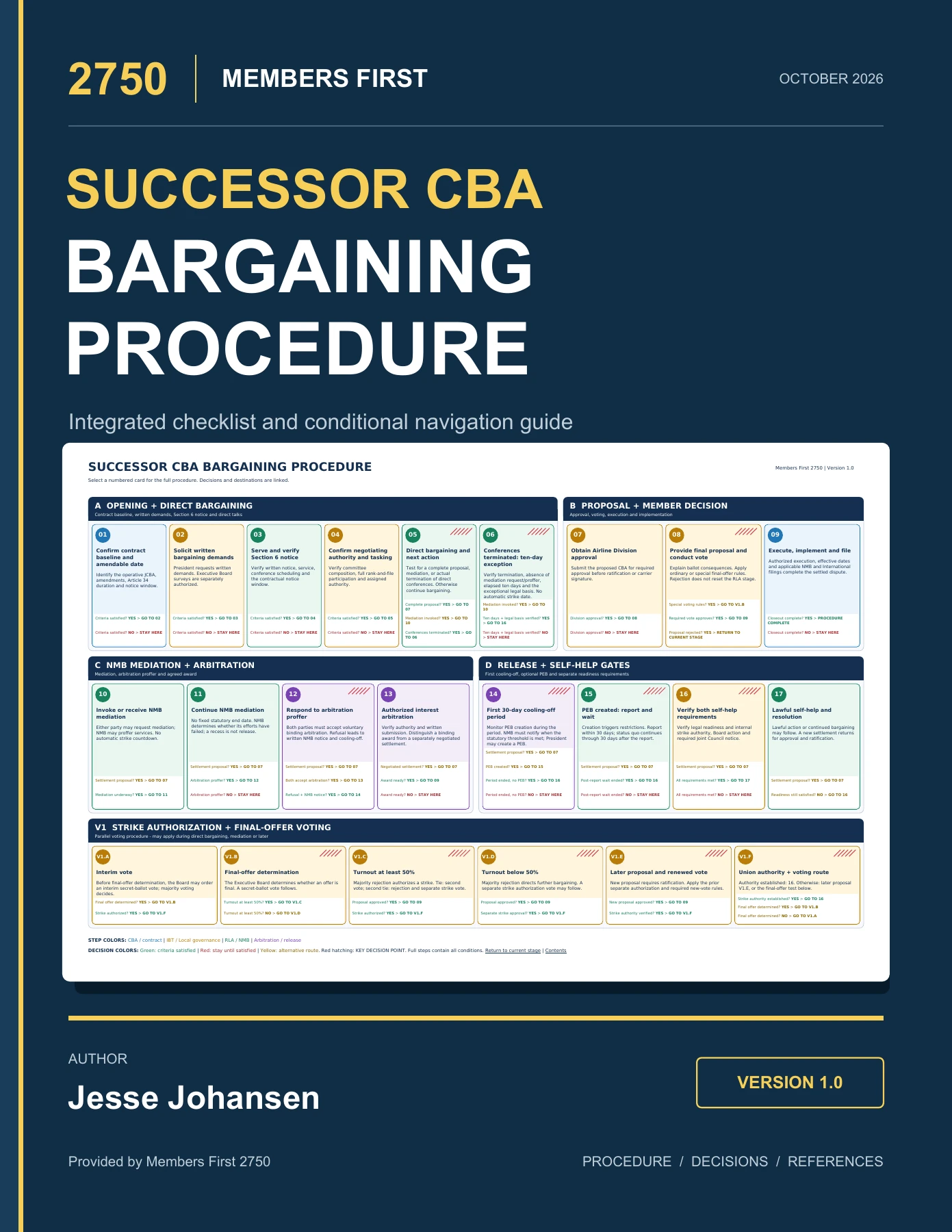 Booklet · Cover + 30 pages Read online →
WATCH THE PROCEDURE
A 4:33 walkthrough of Version 1.0, with continuous narration and enlarged views of the actual PDF. Learn how to use the map, color keys, decision points and progression criteria. English captions are available in the player. The complete wording, conditions and references are available below and in the PDF.
Direct bargaining. Reassessing the next step.
Current IAP 2750 President Yngve Paulsen’s October 16 message describes the latest bargaining session and plans for November. Mediation is being considered; this message does not announce a filing.
Paulsen says the Union’s Negotiating Committee stayed for the full week of the latest session. It then told the Company there was no need to meet again in two weeks.
According to Paulsen’s message, the Union plans to reassess strategy and put its full language proposal on the table at the November meeting.
No exact November meeting date is given.
Paulsen says the Union will decide whether requesting mediation serves the pilots’ interests if it becomes the right step.
How this fits Jesse’s map: the reported activities correspond to step 05 in Version 1.0: direct bargaining and determining the next action. The message describes a pause and plans for November; it does not establish the actual termination of conferences required for step 06. This is our reading of the October 16 account, not independent confirmation of a formal or later status.
Source: Yngve Paulsen, current IAP 2750 President — President’s Message, October 16, 2026. Supplied by the user as an email transcription; the displayed 5:03 p.m. header has no stated time zone.
“We will put our full language proposal on the table so both sides’ positions are clear and we can determine the next steps under the Railway Labor Act. If mediation becomes the right step, we will decide whether requesting it serves the pilots’ interests.”
The economic-proposal issue: according to Paulsen’s account, the Company would not make a comprehensive economic proposal until there was greater alignment on the contract framework. The Company’s original update has not been supplied for comparison.
Limits of this source: the message does not announce a mediation request, NMB release, cooling-off period or strike authorization. It does not establish what happened after October 16. The complete source also contains Paulsen’s opinions and characterizations; those are not presented here as independently established findings.
Read Paulsen’s supplied message in fullDated companion update to the explainer. Newer communications may change this picture. Jesse’s procedure and the video explain the general process.
THE COMPLETE PICTURE
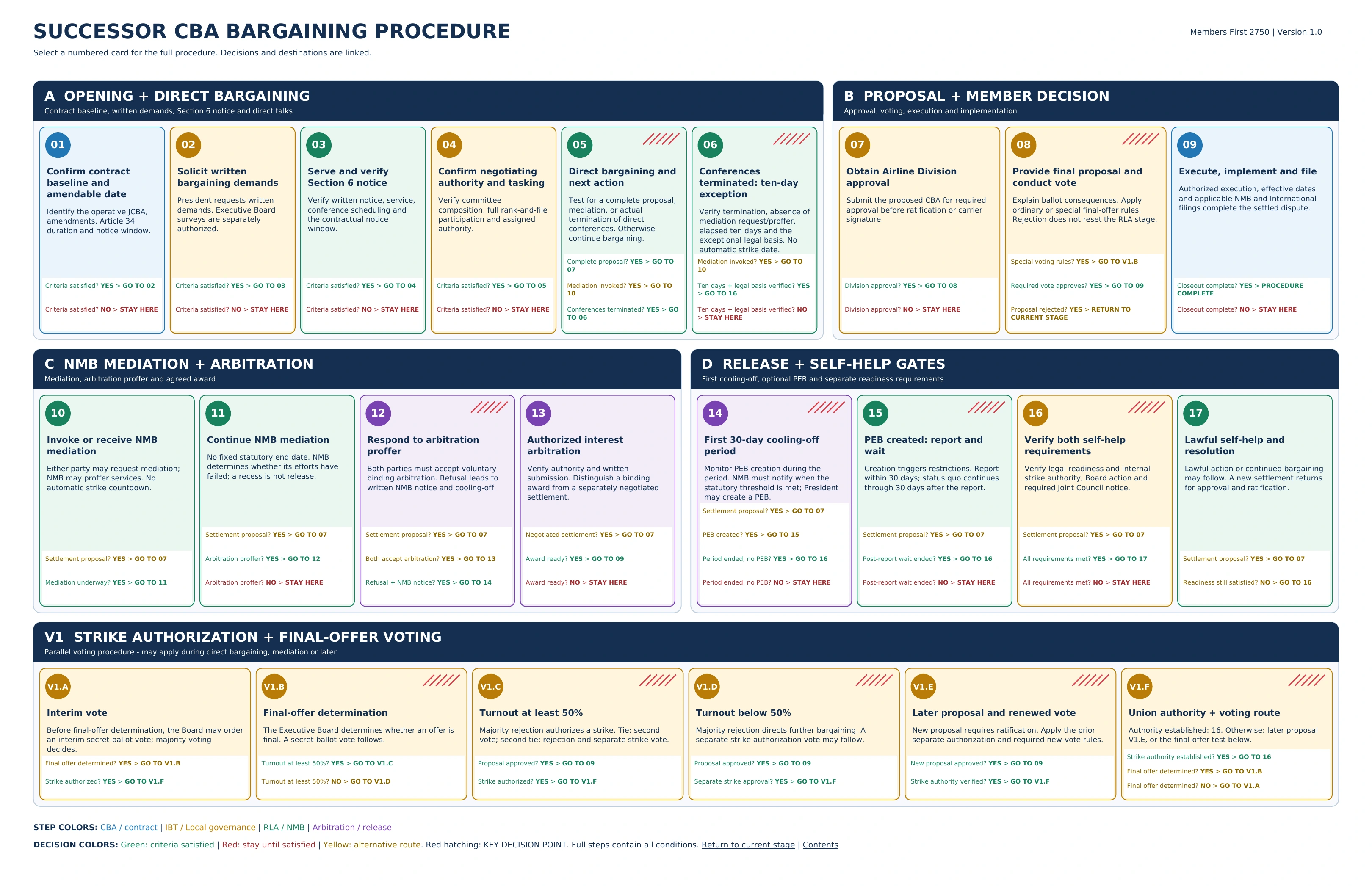
Select a numbered card to open its full explanation. On a small screen, scroll across the map.
VERSION 1.0 · READ AT YOUR OWN PACE
Green: progression criteria satisfied. Red: stay at the current step until the criteria are satisfied. Yellow: an alternative route applies.
Read conditions from top to bottom. Choose the YES or NO direction; continue downward only when directed. Unknown facts require verification before choosing either column.
Identify the existing Atlas Air-IBT JCBA and applicable amendments. The 2021 agreement became effective September 10, 2021 and states an amendable date of September 10, 2026. Article 34 governs duration and successor notice. An amendable date does not automatically end the agreement or authorize a strike.
Record to confirm: Current signed JCBA; Article 34 (printed p. 302); amendment history.
| CONDITION TO TEST | YES | NO |
|---|---|---|
| Contract baseline and amendments verified? | GO TO 02 | STAY HERE |
Existing JCBA and its terms govern unless lawfully changed.
Identify authorized Local actors and governing edition.
The amendable date alone does not complete RLA procedures.
02
When a CBA is about to be negotiated, modified or extended at the Local Union's request, the President shall request written bargaining demands from the membership. The Executive Board decides whether to limit the request by craft/class. Bargaining surveys are separately authorized; they are not automatically the same procedure as soliciting written demands.
Record to confirm: President's request, member submissions, demand compilation, survey instruments and results.
| CONDITION TO TEST | YES | NO |
|---|---|---|
| Required written-demand solicitation documented? | GO TO 03 | STAY HERE |
The JCBA remains operative.
Demand solicitation is assigned by Bylaws Section 27(A); survey authority by Section 14(A)(21).
Notice and preparation may proceed in parallel where permitted.
03
A party proposing changes serves at least 30 days' written notice. Within 10 days after receipt, parties agree on conference time/place; the conference begins within the notice period. Verify the JCBA Article 34 contractual notice window (no more than 270 days before the applicable time), actual service date and proposed changes.
Record to confirm: Actual Section 6 notice, date/service proof, carrier response, scheduled conference.
| CONDITION TO TEST | YES | NO |
|---|---|---|
| Notice, service and conference requirements verified? | GO TO 04 | STAY HERE |
Article 34 governs the contractual notice window.
Document who authorized and transmitted the Local's notice.
Section 6 notice and conference scheduling control.
Confirm the negotiating committee's composition, tasking and decision rules. Under the Constitution, every established and tasked Local negotiating committee must include affected rank-and-file members who fully participate. Officers have a duty to seek settlement; the Executive Board and membership retain separately assigned powers.
Record to confirm: Committee appointment/tasking, Board actions and minutes, objectives and proposals.
| CONDITION TO TEST | YES | NO |
|---|---|---|
| Committee authority and required participation verified? | GO TO 05 | STAY HERE |
Existing rates, rules and conditions continue.
Separate the Local, officers, Executive Board, negotiating committee and membership functions.
Direct Section 6 conferences are available or underway.
Representatives confer and seek a voluntary agreement within their authority. Applicable status quo restrictions continue. Member education and lawful internal voting may proceed during negotiations.
An article-level tentative agreement records progress on a subject. A complete proposed successor package enters the approval and ratification route. If no complete proposal exists, determine whether mediation has been invoked or direct conferences have actually terminated. A recess or a gap between sessions is not necessarily termination.
Record to confirm: Bargaining sessions and proposals; article TAs and any complete package; mediation request/proffer; communications about continuation, recess or termination of conferences.
| CONDITION TO TEST | YES | NO |
|---|---|---|
| Complete proposed settlement reached? | GO TO 07 | Continue to next test |
| NMB mediation requested or proffered? | GO TO 10 | Continue to next test |
| Direct conferences actually terminated? | GO TO 06 | STAY HERE |
PARALLEL OPTION DURING NEGOTIATIONS
| CONDITION TO TEST | YES | NO |
|---|---|---|
| Interim vote being considered? | GO TO V1.A | STAY HERE |
Existing terms generally remain operative during the protected process.
Officers bargain; committee members fully participate; vote provisions remain available.
Parties confer directly; mediation is not automatic.
Section 6 ordinarily restricts carrier changes while notice, conferences or NMB procedures are pending. It contains an exception when ten days have elapsed after conferences terminate without a request for or proffer of NMB services.
Confirm actual termination rather than a recess. Verify the termination date, elapsed period and mediation record. The ten days alone do not establish a lawful strike date. Before relying on this exceptional route, establish its application to this dispute and the other legal and internal requirements checked at Step 16.
Record to confirm: Conference-termination communications and date; date calculation; mediation request/proffer record; documented legal basis for any reliance on the exception.
| CONDITION TO TEST | YES | NO |
|---|---|---|
| Complete proposed settlement reached? | GO TO 07 | Continue to next test |
| NMB mediation requested or proffered? | GO TO 10 | Continue to next test |
| Actual conference termination established? | Continue to next test | GO TO 05 |
| Ten days elapsed after termination without request or proffer? | Continue to next test | STAY HERE |
| Exceptional legal route verified for this dispute? | GO TO 16 | STAY HERE |
Existing agreement does not automatically expire.
Internal strike authority and required notices remain separate.
The ten-day clause is an exception to the Section 6 restriction, not NMB release.
Single approval / ratification route usable from direct talks or mediation. Before member ratification or submission to the carrier for signature, the Local Secretary-Treasurer must submit two copies of all proposed collective bargaining agreements to the Airline Division Director for approval. The sequencing is required by the Local Bylaws; verify its application to a particular proposed LOA, amendment or final offer.
For this successor guide, the usual trigger is a complete proposed agreement. A separate LOA or amendment may itself require approval and a vote; assess that instrument on its own terms. Do not treat an article-level TA as the completed successor.
Record to confirm: Submission, complete proposed text, Division response and any revised language.
| CONDITION TO TEST | YES | NO |
|---|---|---|
| Required Division approval obtained for this proposal? | GO TO 08 | STAY HERE |
No successor contract takes effect merely from a tentative deal.
Airline Division proposal approval precedes ratification/signature.
Settlement path; statutory dispute process need not progress if dispute resolves.
Submit the proposal under Board-adopted ratification procedures. Where a final contract proposal has been reduced to writing at the time of submission for vote, copies must be available to affected members. A majority of voting affected members ordinarily approves an agreement; the Bylaws also preserve specified voting rights for members on layoff. A formal employer final-offer determination invokes special Constitution Article XII rules; see V1.
Ballot materials must explain the consequences of the vote. Article XII Preamble (d) bars union officials from imposing a rejected agreement without the required majority approval. Rejection does not restart or erase the existing RLA stage; use X2 to resume it.
Record to confirm: Board referendum procedures, final written package, notice, ballot, tally and report.
| CONDITION TO TEST | YES | NO |
|---|---|---|
| Later proposal governed by Article XII 1(b)(3)? | GO TO V1.E | Continue to next test |
| Board has determined an employer final offer? | GO TO V1.B | Continue to next test |
| Ordinary ratification vote completed? | Continue to next test | STAY HERE |
| Proposal approved by the required majority? | GO TO 09 | RETURN TO CURRENT STAGE |
Existing terms remain until lawful implementation of a successor.
Affected membership votes; final-offer rules require special handling.
Bargaining may continue or resume after rejection.
Complete execution by authorized signatories, effective-date provisions and implementation. The carrier must file with the NMB the new contract or change within 30 days after execution or effectiveness as the statute provides. The Secretary-Treasurer must also submit true copies to the International's Economic and Contracts Departments within 60 days after execution, as prescribed. For a binding arbitration award, follow the award and arbitration-agreement requirements rather than assuming an ordinary ratification path.
Local reporting also includes the prescribed employer names and locations and number of covered employees. The Secretary-Treasurer submits the annual list of agreements in effect as of January 1 under Bylaws 27(C).
When the execution, implementation and applicable filing requirements are complete, this procedure is complete for the settled dispute.
Record to confirm: Executed text, ratification/approval proof, implementation notice, NMB filing receipt.
| CONDITION TO TEST | YES | NO |
|---|---|---|
| Execution, implementation and applicable filings complete? | PROCEDURE COMPLETE Return to Overview | STAY HERE |
New terms become operative on their prescribed effective dates.
Confirm proper signatures, report filing and member communication.
Carrier NMB filing requirement is triggered; RLA dispute resolved to the extent settled.
10
Mediation has no fixed completion date. Either party may request National Mediation Board services for an unresolved Section 6 dispute; the NMB can also proffer services. Submission to mediation does not begin a strike countdown and does not guarantee immediate NMB release. Record the application, case number and mediator communications.
Record to confirm: Mediation application/proffer, NMB docket, assigned mediator, current status.
| CONDITION TO TEST | YES | NO |
|---|---|---|
| Complete proposed settlement reached? | GO TO 07 | Continue to next test |
| NMB mediation underway? | GO TO 11 | STAY HERE |
Applicable status quo continues.
Negotiating representatives and member-organizing activities remain active.
NMB jurisdiction and mediation procedures govern; no fixed waiting or end date.
The NMB uses its best efforts to achieve agreement and controls whether mediation remains productive. There is no fixed statutory deadline for ending mediation. Recesses and further sessions do not themselves constitute release. A settlement can occur at any time and then enters the union approval/ratification process.
Record to confirm: Written NMB communications, active/recessed status, signed tentative texts.
| CONDITION TO TEST | YES | NO |
|---|---|---|
| Complete proposed settlement reached? | GO TO 07 | Continue to next test |
| NMB has made its arbitration proffer? | GO TO 12 | STAY HERE |
Existing terms and required status quo continue.
Membership education, organization and internal votes can continue.
Only the NMB moves from exhausted mediation to the arbitration-proffer route.
If further mediation fails, the NMB endeavors to induce submission of the controversy to voluntary binding arbitration. Acceptance by both sides leads to an agreed arbitration procedure; refusal by either side leads to a written NMB notice of failed mediation and a 30-day cooling-off period.
Record to confirm: NMB proffer, parties' responses, any signed arbitration agreement.
| CONDITION TO TEST | YES | NO |
|---|---|---|
| Complete proposed settlement reached? | GO TO 07 | Continue to next test |
| Both parties accept authorized binding arbitration? | GO TO 13 | Continue to next test |
| Refusal and written NMB failure notice confirmed? | GO TO 14 | STAY HERE |
Existing terms remain during unresolved statutory proceedings.
Any arbitration agreement must be reviewed for internal authorization.
NMB proffer and either acceptance or refusal controls the fork.
Interest arbitration determines new contract terms for the issues the parties submit. It differs from grievance arbitration, which interprets or applies existing terms.
Before committing to binding arbitration, verify the representatives' authority and any required internal approvals. The written submission controls the questions and scope. Authority to submit the dispute is a separate issue from whether a later award is subject to ratification. The award is not automatically an ordinary TA, and this route is not blanket permission to bypass member voting rights.
Follow the signed submission, the award, and applicable statutory filing and review provisions. A separately negotiated settlement returns through Steps 07-08.
Record to confirm: Signed arbitration agreement, stipulated questions, award, filing and implementation.
| CONDITION TO TEST | YES | NO |
|---|---|---|
| Separate negotiated settlement reached? | GO TO 07 | Continue to next test |
| Award ready for implementation under governing rules? | GO TO 09 | STAY HERE |
Award or agreement determines changes on specified terms.
Consult the arbitration agreement, authorized signatories and applicable internal rules.
RLA arbitration procedures replace the ordinary release/self-help route for submitted issues.
After unsuccessful mediation and refusal of the NMB's arbitration proffer, the NMB gives written notice that mediation failed. The first 30-day cooling-off period runs from that notice. Confirm the controlling dates; a mediation application or party declaration of impasse does not start this clock.
Monitor the PEB question during this period. If the NMB judges that the unresolved dispute threatens a substantial interruption of interstate commerce depriving a section of the country of essential transportation service, it must notify the President. The President may create a PEB. Notification alone does not create a PEB or trigger its additional restrictions.
The decision test is whether a PEB has actually been created. A later agreement to arbitrate also changes the route. Otherwise maintain the applicable status quo until the first period ends, then verify Step 16.
Record to confirm: NMB failure notice and dates; any NMB presidential notification; executive order creating a PEB; arbitration agreement; settlement record.
| CONDITION TO TEST | YES | NO |
|---|---|---|
| Complete proposed settlement reached? | GO TO 07 | Continue to next test |
| PEB created? | GO TO 15 | Continue to next test |
| Parties have agreed to authorized arbitration? | GO TO 13 | Continue to next test |
| First 30-day period ended with no PEB created? | GO TO 16 | STAY HERE |
Status quo restrictions apply during the cooling-off period.
Internal authorization does not itself permit an immediate strike.
NMB written notice and statutory 30 days control.
Enter this step when the President creates a Presidential Emergency Board. Under 45 U.S.C. 160, the board investigates and reports within 30 days of creation. The parties may not change the conditions in dispute, except by agreement, from creation through 30 days after the report.
Record the actual creation and report dates and any applicable action affecting the deadlines. The PEB's recommendations do not themselves create a binding successor CBA. A negotiated settlement still follows Steps 07-08.
Record to confirm: NMB notification, executive order (if any), PEB report and all deadline dates.
| CONDITION TO TEST | YES | NO |
|---|---|---|
| Complete proposed settlement reached? | GO TO 07 | Continue to next test |
| Report issued and required post-report period ended? | GO TO 16 | STAY HERE |
Applicable status quo continues through the PEB restriction.
Negotiation, preparation and internal votes do not override statutory restrictions.
Creation triggers this branch; the report anchors the additional 30 days.
Before calling a strike, verify both that the RLA process permits lawful self-help and that the union has constitutional strike authority. Article XII permits interim strike votes and addresses final-offer rejection; see V1. Officers must use reasonable means to achieve settlement under Bylaws Section 27(D); the Executive Board has discretion over a properly authorized strike. The Local Secretary-Treasurer must notify the Joint Council at least 48 hours before a strike; Section 27(F) also requires immediate notification for contemplated picketing, lawsuits or serious difficulty.
Use this as a readiness check, not an instruction to strike. Any asserted Section 6 exception needs its own documented legal basis. Outstanding legal conditions or internal authorization requirements mean hold and resolve them.
Record to confirm: Strike vote tally and category, LUEB decision, RLA dates, Joint Council notice receipt.
| CONDITION TO TEST | YES | NO |
|---|---|---|
| Complete proposed settlement reached? | GO TO 07 | Continue to next test |
| PEB restriction remains in effect? | GO TO 15 | Continue to next test |
| First cooling-off period remains in effect? | GO TO 14 | Continue to next test |
| Internal strike authority established? | Continue to next test | GO TO V1.F |
| All legal and internal requirements verified? | GO TO 17 | STAY HERE |
Post-exhaustion lawful changes may become available; no automatic lapse on amendable date.
Board authority, member authorization and Joint Council notice must be verified.
All release/cooling-off and PEB restrictions must have elapsed.
If statutory and union preconditions are satisfied, the dispute may involve a lawful strike, carrier lockout, other lawful self-help or continued negotiations. A strike does not itself create a successor CBA. Bargaining can continue and the parties may reach a negotiated settlement at any point. Exceptional governmental or judicial action can affect the route and should be assessed separately.
Record to confirm: Action notices, updated offers, settlement language, agreed return-to-work terms.
| CONDITION TO TEST | YES | NO |
|---|---|---|
| Complete proposed settlement reached? | GO TO 07 | Continue to next test |
| Conditions for contemplated action remain satisfied? | Continue lawful action / bargaining here | GO TO 16 |
Terms may change lawfully after exhaustion, depending on action and law.
Union governance and settlement approvals still apply to a later agreement.
Statutory path exhausted only if every applicable condition was met.
V1.A
Before a Board final-offer determination, the Board may order a secret-ballot vote on strike authorization or an employer proposal; a majority of voters decides. Record exactly what was authorized. Internal voting does not start an RLA countdown.
Record to confirm: Board determination and procedures; ballot and explanatory materials; eligible voter count; valid ballots; tally; any prior authorization and required notices.
| CONDITION TO TEST | YES | NO |
|---|---|---|
| Board has determined an employer final offer? | GO TO V1.B | Continue to next test |
| Interim vote authorized a strike? | GO TO V1.F | RETURN TO CURRENT STAGE |
V1.B
The Local Executive Board determines whether an employer offer is final, regardless of its label. Once determined final, it must go to a secret-ballot vote. Complete Step 07 approval and Step 08 materials first; record eligibility, turnout and valid ballots.
Record to confirm: Board determination and procedures; ballot and explanatory materials; eligible voter count; valid ballots; tally; any prior authorization and required notices.
| CONDITION TO TEST | YES | NO |
|---|---|---|
| Required proposal approval and voting materials complete? | Continue to next test | GO TO 07 |
| Final-offer vote completed? | Continue to next test | STAY HERE |
| At least half of eligible members cast valid ballots? | GO TO V1.C | GO TO V1.D |
V1.C
A cumulative majority accepting the final offer approves it. A cumulative majority rejecting it authorizes a strike without another authorization vote. A tie requires a second vote; a second tie rejects the proposal and requires a separate strike vote. Record which vote produced the result.
Record to confirm: Board determination and procedures; ballot and explanatory materials; eligible voter count; valid ballots; tally; any prior authorization and required notices.
| CONDITION TO TEST | YES | NO |
|---|---|---|
| Proposal accepted by required majority? | GO TO 09 | Continue to next test |
| Majority rejection or separate strike vote established strike authority? | GO TO V1.F | Continue to next test |
| Required tie-resolution voting completed? | RETURN TO CURRENT STAGE | STAY HERE |
V1.D
Majority acceptance approves the final offer. Majority rejection directs further negotiations and does not automatically authorize a strike. The Board may conduct a separate strike vote; majority approval gives it discretion subject to applicable law. A vote that does not produce a stated outcome must be resolved under the governing rules.
Record to confirm: Board determination and procedures; ballot and explanatory materials; eligible voter count; valid ballots; tally; any prior authorization and required notices.
| CONDITION TO TEST | YES | NO |
|---|---|---|
| Proposal accepted by required majority? | GO TO 09 | Continue to next test |
| Separate strike vote authorized a strike? | GO TO V1.F | Continue to next test |
| Outcome determined without strike authorization? | RETURN TO CURRENT STAGE | STAY HERE |
V1.E
Under Article XII 1(b)(3), a new proposal from further negotiations must be submitted for ratification. Majority approval accepts it. If rejected again, prior separate strike authorization under (2) permits Board discretion; if no strike vote was conducted, a separate vote is required. A prior vote that denied authorization does not authorize a strike.
Record to confirm: Board determination and procedures; ballot and explanatory materials; eligible voter count; valid ballots; tally; any prior authorization and required notices.
| CONDITION TO TEST | YES | NO |
|---|---|---|
| Required Division approval obtained? | Continue to next test | GO TO 07 |
| Renewed ratification vote completed? | Continue to next test | STAY HERE |
| New proposal approved by required majority? | GO TO 09 | Continue to next test |
| Applicable separate strike authorization established? | GO TO V1.F | Continue to next test |
| Required separate vote and applicable rules resolved? | RETURN TO CURRENT STAGE | STAY HERE |
Identify the source and result of any applicable strike authorization. If established, verify the remaining legal requirements, Board action and notices at Step 16. If authorization is missing, determine the applicable voting route below.
A later proposal governed by Article XII 1(b)(3) uses V1.E. Otherwise, a Board final-offer determination points to V1.B; before that determination, V1.A explains the available interim-vote procedure. Referral to V1.A does not itself order or authorize a vote. An internal vote never establishes a lawful strike date.
Record to confirm: Board determination and procedures; ballot and explanatory materials; eligible voter count; valid ballots; tally; any prior authorization and required notices.
| CONDITION TO TEST | YES | NO |
|---|---|---|
| Applicable strike authorization already established? | GO TO 16 | Continue to next test |
| Later proposal governed by Article XII 1(b)(3)? | GO TO V1.E | Continue to next test |
| Board has determined an employer final offer? | GO TO V1.B | GO TO V1.A |
Rejection of a proposal or an internal vote does not restart the RLA process. Use the recorded facts to return to the applicable step. If a deadline or legal status is uncertain, verify it before proceeding.
| CONDITION TO TEST | YES | NO |
|---|---|---|
| Complete new proposed settlement reached? | GO TO 07 | Continue to next test |
| Binding arbitration governs unresolved issues? | GO TO 13 | Continue to next test |
| PEB restrictions remain in effect? | GO TO 15 | Continue to next test |
| NMB release issued and first cooling-off period remains? | GO TO 14 | Continue to next test |
| Applicable waiting periods ended or other lawful route verified? | GO TO 16 | Continue to next test |
| NMB arbitration proffer awaits response or failure notice? | GO TO 12 | Continue to next test |
| NMB mediation remains active or recessed? | GO TO 11 | Continue to next test |
| Dispute remains in direct bargaining? | GO TO 05 | STAY HERE |
Use this checklist for a negotiated settlement reached during direct bargaining, mediation or later. For an arbitration award, follow the award-specific rules.
Record to confirm: Airline Division approval of the proposed collective bargaining agreement documented.
Record to confirm: Written final proposal made available to affected members when required.
Record to confirm: Membership vote and result documented under the applicable Article XII and Local procedures.
Record to confirm: Authorized execution, effective dates, implementation and member notice confirmed.
Record to confirm: Carrier NMB filing deadline tracked under 45 U.S.C. 155 Third(e).
Record to confirm: Local International filing within 60 days after execution tracked, including required employer and employee information. Annual January 1 reporting recorded.
| CONDITION TO TEST | YES | NO |
|---|---|---|
| Applicable closeout requirements completed? | GO TO 09 | STAY HERE - complete checklist |
CBA / JCBA: Collective bargaining agreement / joint collective bargaining agreement.
Amendable date: Date tied to renegotiation; it does not automatically terminate the agreement or authorize a strike.
TA: Tentative agreement. Identify whether it covers an article or a complete proposed successor.
NMB / PEB: National Mediation Board / Presidential Emergency Board.
LUEB: Local Union Executive Board.
Proffer: An NMB offer of services or arbitration; identify which is meant.
Status quo: Applicable restrictions on changes to pay, rules, working conditions and established practices during the dispute process.
Self-help: Lawful economic action after applicable legal conditions are met. Union strike authority must also be established.
Interest arbitration: Agreed adjudication of new terms, distinct from arbitration of an existing-contract grievance.
Ratification: Affected members vote to approve or reject a proposed agreement under the governing rules.
Does an article TA mean we have a successor? See 05
What does a rejection vote do? See V1.B
Has the first cooling-off period started? See 14
Does notifying the President create a PEB? See 14
Can a strike begin now? See 16
Contract obligations, union governance and the RLA operate together. This reference summarizes their relationship; the full steps and applicable exceptions control.
| MILESTONE | CBA / CONTRACT | IBT / LOCAL | RLA / NMB |
|---|---|---|---|
| Preparation | Operative JCBA; Article 34 window. | Written demands; committee tasking. | Notice and conference preparation. |
| Direct bargaining | Existing terms generally maintained. | Negotiate; educate; interim votes. | Conferences and applicable status quo. |
| Complete proposal | No successor solely from a TA. | Division approval; member vote. | Settlement can occur at any stage. |
| Mediation | Applicable status quo continues. | Bargaining and preparation continue. | NMB directs process; no fixed end date. |
| Release / PEB | Status quo during required waiting periods. | A vote alone does not establish a lawful date. | NMB notice; optional PEB creation and report. |
| Self-help / resolution | Lawful changes may become possible. | Strike authority, Board action and notices. | Applicable legal conditions must be met. |
| Executed successor | New terms on prescribed effective dates. | Execution, reporting and member communication. | Carrier filing within applicable 30 days. |
Specific authorities accompany each step. Select a linked reference to read the source provision. The guide addresses successor bargaining and the airline PEB route under Section 160.
45 U.S.C. 152 - Duties and status quo
45 U.S.C. 155 - Mediation; First cooling-off; Third(e) carrier filing
45 U.S.C. 156 - Section 6 notice, conferences and ten-day exception
45 U.S.C. 157 - Voluntary arbitration
45 U.S.C. 158 - Written arbitration agreement
45 U.S.C. 159 - Award and judicial review
45 U.S.C. 160 - Presidential Emergency Board
IBT Constitution (2021) - Article XII Preamble and Section 1; printed pp. 85-89.
Local 2750 Bylaws (2020) - Sections 14(A)(21), 25 and 27(A)-(F). Section 27 appears at printed pp. 59-61.
Atlas Air-IBT JCBA (2021) - Article 34, printed p. 302; operative amendments also apply.
NMB Mediation Overview and FAQ
THE COMPLETE DOCUMENT
Cover · 30-page procedure · Select the page image to view it at full size.